 Columbus OVI/DUI Attorney Blog


 As a community, we want to protect children. For that reason, some criminal laws in Ohio have increased penalties when the prohibited conduct affects juveniles. One such proposed law is currently before the Ohio General Assembly. If passed, the bill would enhance some vehicular offenses which occur in an active school zone and raise penalties for other traffic offenses which occur in a school-adjacent sector.
Aspen Runnel’s Law
The proposed legislation is House Bill 203, known as Aspen Runnels’ Law. The Bill was prompted by two crashes involving students walking to and from school in Ohio’s Lakota Local School District. One of those students, Aspen Runnels, died after being struck by a vehicle in a crosswalk in 2024. In response, Ohio Representatives Thomas Hall and Josh Williams introduced House Bill 203.
 The Ohio laws prohibiting Vehicular Homicide and Vehicular Assault only apply if certain vehicles are used in the commission of the offense. For example, someone who causes the death of another person while riding a bicycle under the influence cannot be convicted of Aggravated Vehicular Homicide because ‘bicycle’ is not a vehicle listed in the statutes. The list of applicable vehicles has changed over the last couple years and will soon change again.
 When a celebrity is charged with driving under the influence, the legal proceedings often generate headlines which capture public attention. While many readers focus on the celebrity involved, some readers notice something else entirely: the legal issues unfolding behind the scenes. In the Tiger Woods DUI case, the recent legal issue was whether the prosecution can obtain Woods’ hospital records.
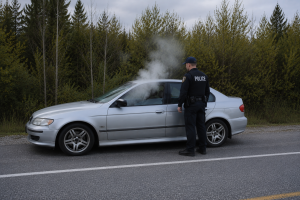 When a police officer stops a motorist, the officer may smell the odor of burned marijuana coming from inside the motorist’s vehicle. There was a time in Ohio when that odor alone would permit the officer to detain the driver and search the vehicle. That was before recreational marijuana was legalized. Now that recreational marijuana use is legal, the odor of burned marijuana, by itself, does not justify seizing the driver or searching the vehicle. This change has implications for DUI cases (called ‘OVI’ in Ohio) involving suspected marijuana intoxication.
 I was recently interviewed by Steve Sleeper for his
  The Ohio Supreme Court recently issued a decision in
  An 18-year-old Ohio man was charged with DUI (called ‘OVI’ in Ohio) and other offenses after hitting a school bus carrying students. According to
 A driver struck a trooper while the trooper was directing traffic, and the trooper suffered serious injuries. The driver submitted a urine sample, and a urine test showed a concentration of inactive marijuana metabolite above the ‘legal limit’. The driver was charged with and convicted of Aggravated Vehicular Homicide and DUI (called ‘OVI’ in Ohio). The Ohio Supreme Court
  An Ohio man was involved in a single-car accident. Officers responded to the accident scene and suspected the man was under the influence. The officers requested that the man perform field sobriety tests, and